
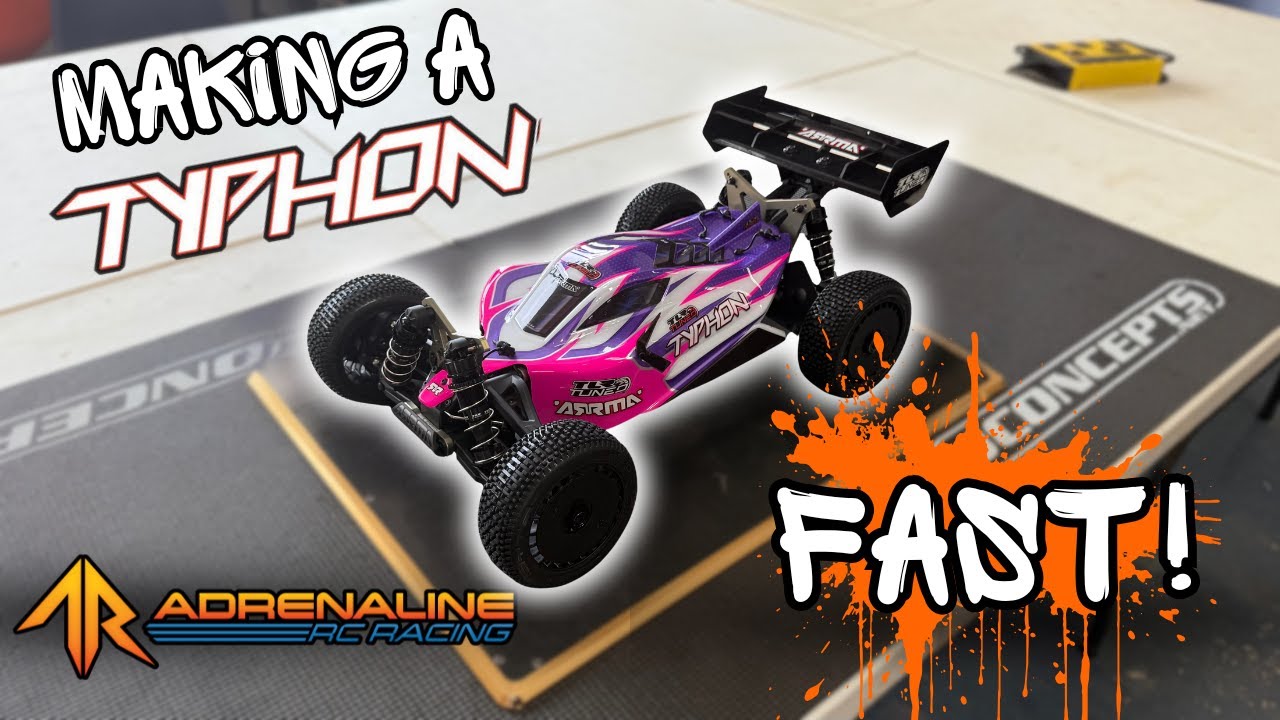
Welcome back to the Adrenaline RC blog! Today marks the launch of an exciting new series on our YouTube channel — and I’m diving headfirst into a challenge many of you have probably considered: Can a ready-to-run (RTR) style car be competitive on the track?
To put it to the test, I’m starting with the TLR Tuned Typhon Roller — a unique hybrid between a true RTR and a full race kit. It’s not a completely built-out racer, but it’s also not your standard beginner bash buggy. It comes assembled but leaves room for personal electronics and setup — making it the perfect candidate for this experiment.
Let’s break down the project and take a look under the hood.
🔧 What Makes the TLR Tuned Typhon Unique?
Out of the box, the Typhon is packed with tuning potential. Even as a roller, it offers:
-
Threaded aluminum shocks (standard 16mm size)
-
Adjustable front and rear suspension blocks (A, B, C, D) with square pills
-
Pillow ball front suspension for precise camber and steering tuning
-
Multiple upper shock mounting positions (5 on the towers)
-
Front sway bar and turnbuckles
-
Solid body styling with RTR aesthetics
The rear setup is particularly interesting — it runs a dog bone system rather than CVAs like the front. That's a rare split design you don’t often see on race cars. The wing and mount are also unique, bolting to the rear center rather than the tower, offering a few tuning options for height and position.
Overall, the car includes tons of adjustability that mimic race kits — just at a more accessible price point.
🔍 Center Layout & Weight Balance
Looking at the electronics layout, the car is very symmetrical. The motor and ESC sit on one side, and the battery and receiver box are on the other. The center diff sits slightly rearward, which should bias weight toward the back — something we’ll pay attention to when tuning the handling.
📦 Inside the Box
The included accessories and tuning parts are generous for an RTR-style car. Here’s what comes with it:
-
Setup pill inserts (for upper arms and suspension blocks)
-
Rear wing flaps for adjustable downforce
-
Diff shims (for gear longevity)
-
Wheel wrench, servo mounting hardware, and more
-
Setup sheet & tuning guide
The tuning guide is especially helpful — it provides insight into the stock setup and what changes in diff oils, sway bars, and pills will do to handling. You’ll want to keep this close as we go deeper into setup changes.
🛠️ Stock Setup Specs
According to the manual, the stock fluid specs are:
-
Diff oils:
-
Front: 7,000 CST
-
Center: 10,000 CST
-
Rear: 7,000 CST
-
-
Shock oil:
-
550 CST front and rear (about 42.5 wt)
-
Pistons: 4-hole in front, 8-hole in rear (very unusual combo!)
-
These are neutral baselines, and we’ll definitely revisit them after a few shakedown runs.
🎯 The Goal of the Series
The plan is simple: Tune it, race it, and find out what this TLR Typhon is capable of.
We’re going to treat it like a race kit — tuning, testing, and refining as we go. It’s a great case study for hobbyists looking to transition from bashing to racing without dropping top dollar on a full competition platform.
We'll be testing:
-
Electronics installs (servo, motor, ESC choices)
-
Track performance and tuning tweaks
-
Durability and upgrade paths
🔜 What’s Next?
In the next episode, we’ll install electronics and get this buggy track-ready. I’ll go over servo and ESC choices, motor pairing, and any other pre-race prep needed before we hit the dirt.
So if you’ve ever wondered if a mid-tier platform like the TLR Typhon can keep up with full-blown race kits — you’re in for a great series.
Stay tuned, and let’s see how far we can take this build!
— Jacob