
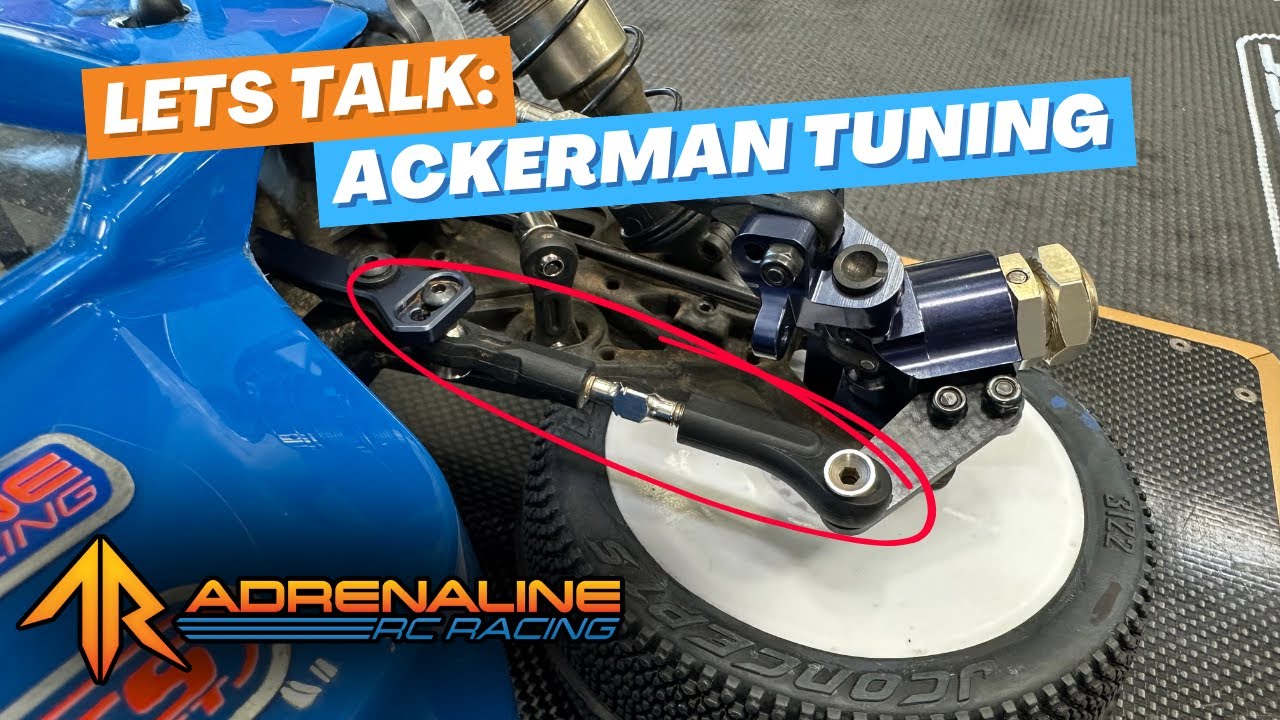
When it comes to fine-tuning your RC race car’s handling, one often overlooked—but incredibly important—adjustment is Ackermann steering. Whether you're chasing better corner entry, more predictable mid-corner behavior, or refined exit steering, adjusting Ackermann can have a major impact on your driving performance.
In this guide, we’ll walk through what Ackermann is, how it affects your RC car, and how to tune it both at the steering rack and the outer plates. If you're new to this concept or looking to take your tuning to the next level, you're in the right place.
What is Ackermann?
Ackermann refers to the difference in steering angle between the inside and outside front tires as the car turns. In a perfect world, the inside tire should turn at a sharper angle than the outside tire to maintain an ideal arc through the corner. By adjusting Ackermann, you can manipulate how aggressively or smoothly your car initiates and exits turns.
Where Can You Adjust Ackermann?
There are two primary locations where Ackermann can be adjusted on most RC race cars:
-
The Steering Rack (central portion of the chassis)
-
The Steering Plates (at the wheel hubs or uprights)
Adjusting Ackermann at the Steering Rack
Link Positioning:
-
Rearward Position (More Ackermann):
-
Increases initial steering response
-
Makes the car feel snappier as you enter the corner
-
May reduce steering mid-corner and on exit
-
-
Forward Position (Less Ackermann):
-
Reduces initial steering bite
-
Feels more stable entering turns
-
Gains steering mid-to-exit, providing more consistent cornering
-
Quick Tip:
More Ackermann = more aggressive on entry
Less Ackermann = smoother transitions and stronger follow-through
Adjusting Ackermann at the Steering Plates
Shorter Plate (Link Mount Closer to Wheel):
-
Gives more initial response
-
Often results in a quicker, more reactive steering feel
Longer Plate (Link Mount Closer to Rack):
-
Smooths out the steering
-
Enhances mid-corner to exit steering stability
Some setups also allow for forward/backward positioning of the link on the plate:
-
Forward Link Position = More Initial Steering
-
Rearward Link Position = Stronger Follow-Through
How Ackermann Affects Track Performance
The ideal Ackermann setup depends on track layout, traction levels, and your driving style. For tight, technical tracks, more initial steering might help you dart into corners more effectively. On sweeping or high-speed layouts, smoother mid-to-exit steering can lead to better lap times.
Final Thoughts
Tuning Ackermann can feel a little technical at first, but once you understand the cause-and-effect of each adjustment, it becomes a powerful tool in your setup arsenal. Don’t forget to recheck your static toe and steering endpoints after making changes.
If you're unsure where to start, begin with your steering rack. Test both forward and rearward positions and note how your car behaves through each phase of a corner. Then, dive into plate adjustments for finer control.
💬 Got questions or want us to cover another tuning topic? Drop a comment on the video or reach out through our website!
🛒 Need parts or tuning gear? Visit www.adrenalinercracing.com