
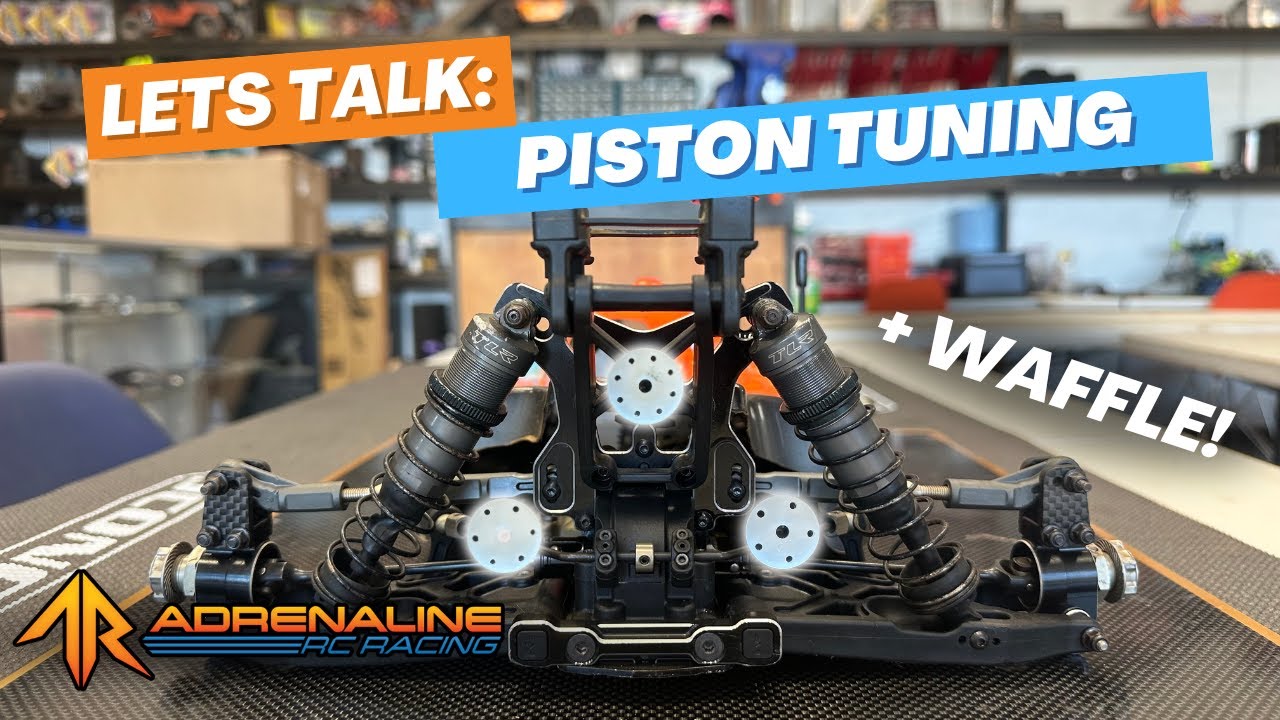
Shock tuning is one of the most confusing parts of RC setup—no question about it. In this installment of our Shock Tuning Guide: Let’s Talk Series, we’re breaking things down and focusing on shock pistons: what they do, how they differ, and when you should consider changing them.
This guide is meant to give you practical, real-world understanding, especially if you’re a weekend racer who wants their car to feel better without getting lost in extreme theory.
What Are Shock Pistons and Why Do They Matter?
Shock pistons control how oil flows through your shock, which directly affects how fast the suspension reacts to bumps, landings, and weight transfer.
Changing pistons can:
-
Make your car absorb bumps better
-
Improve grip on different track surfaces
-
Adjust how reactive or stable the car feels
Instead of going ultra-technical, we’ll focus on the basics that actually matter at the track.
Common Shock Piston Hole Counts
The most common pistons you’ll see are:
-
5-hole pistons
-
6-hole pistons
-
8-hole pistons
(Yes, there are others—like 10-hole or 20-hole pistons—but these three cover the majority of setups.)
How Hole Count Affects Performance
-
5-Hole Pistons
-
Faster reacting
-
Best for rough or bumpy tracks
-
Allows oil to move quickly
-
-
8-Hole Pistons
-
Slower reacting
-
Better for smooth, high-grip tracks
-
Smaller holes restrict oil flow
-
-
6-Hole Pistons
-
The most balanced and versatile
-
Not the fastest or slowest
-
Works well across many conditions
-
👉 If you want one piston that works almost everywhere, 6-hole pistons are a great choice.
Hole Size Matters (Not Just Hole Count)
This is where a lot of people get confused.
Even though an 8-hole piston has more holes, those holes are usually smaller.
Typical hole sizes:
-
5-hole pistons: ~1.4–1.6 mm
-
6-hole pistons: ~1.3–1.5 mm
-
8-hole pistons: ~1.2–1.3 mm
Larger holes = oil flows faster = more reactive shock
Smaller holes = oil flows slower = smoother, slower response
Piston Shapes: Flat vs Taper vs Bypass
Flat Pistons
-
Same on both sides
-
Similar upstroke and downstroke feel
-
Predictable and consistent
Tapered Pistons
-
Faster downstroke than upstroke
-
Helps the shock rebound quicker
-
Useful when you want better bump absorption
MIP Bypass Pistons
-
Flat base with adjustable valve flaps
-
Lets you fine-tune rebound without changing pistons
-
More tuning options, but not required for most racers
Track Conditions & Piston Selection
| Track Type | Recommended Piston |
|---|---|
| Rough / Bumpy | 5-hole |
| Smooth / High Grip | 8-hole |
| Mixed / General | 6-hole |
Common Front & Rear Piston Setups
Most setups run the rear slightly softer than the front for better overall grip and drivability.
5-Hole Setup
-
Front: 5×1.4
-
Rear: 5×1.5
(or 5×1.5 front / 5×1.6 rear)
6-Hole Setup (Split Drilled)
-
Front: 3 holes at 1.3 + 3 holes at 1.4
-
Rear: 3 holes at 1.4 + 3 holes at 1.5
(Alternate the holes for balance.)
8-Hole Setup
-
Front: 8×1.2
-
Rear: 8×1.3
Using MIP Bypass Pistons (Optional)
MIP bypass pistons let you adjust rebound using valve flaps:
-
Clear flap: stiffest
-
Green flap: medium
-
Blue flap: softest
Common setup:
-
Front: Clear flap
-
Rear: Blue flap
This gives:
-
Similar upstroke front and rear
-
Faster rebound in the rear for better bump handling
You can run matching flaps front and rear if you want a flat-piston feel.
💡 Real talk: these pistons are nice, but they won’t magically make you faster. Once you find a setup you like, you’ll rarely change them.
MIP 1/8 Bypass1 Hi-Flow Piston Kit (4) (6-Hole x 1.3mm)
MIP 1/8 Bypass1 Hi-Flow Piston Kit (4) (8-Hole x 1.2mm)
Should You Drill Pistons Further?
Sometimes racers drill one hole slightly larger to make tiny adjustments.
This is:
-
Extremely fine tuning
-
Mostly noticeable by top-level drivers
For most racers, stick to standard hole sizes and don’t overthink it.
Keep It Simple
Shock tuning can spiral fast. The best advice?
-
Pick a piston setup that works everywhere
-
Tune oil and springs for conditions
-
Spend more time driving, less time stressing
A consistent car you understand is better than chasing tiny setup changes.