
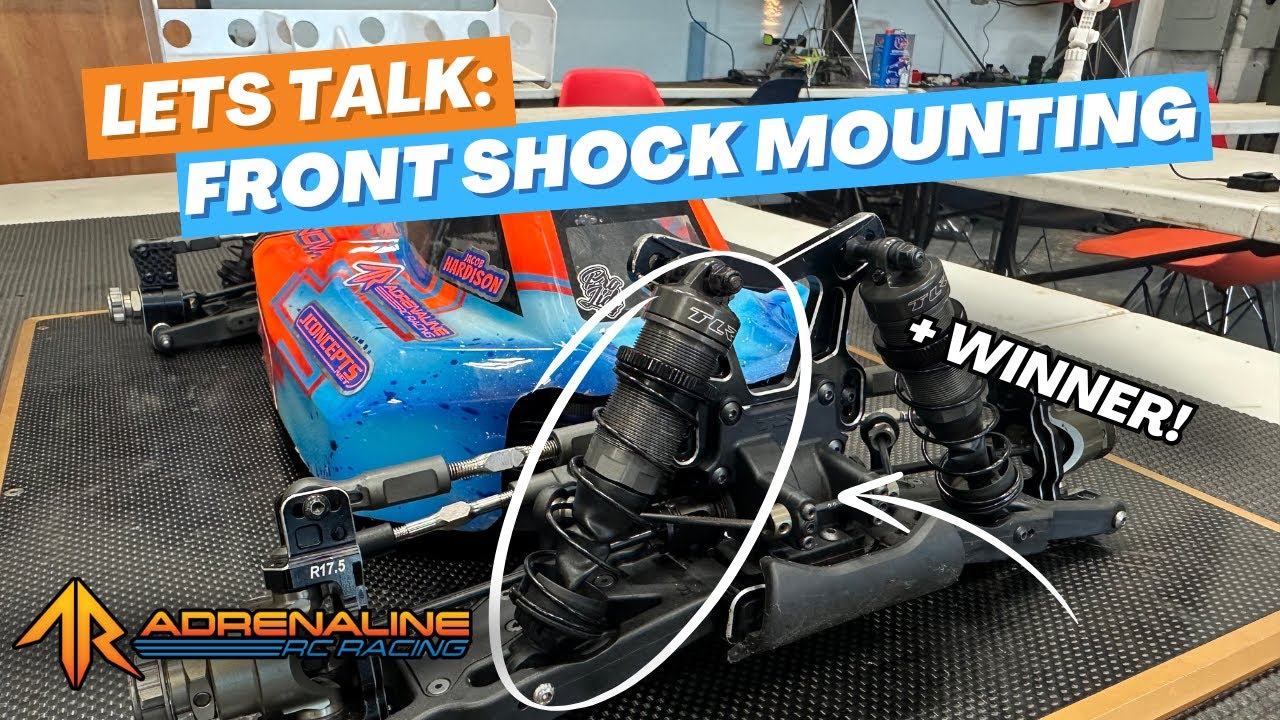
Shock tuning is one of the most confusing parts of setting up a 1/8 scale RC buggy — and mounting position is where most racers get lost first. In this installment of our Let's Talk tuning series, Jacob Hardison walks through exactly how moving your front shock between the upper tower holes and lower arm holes changes steering response, dampening feel, and weight transfer on track.
Below is the full breakdown, plus the video itself if you want to see the mounting points up close.
Inclined vs. Less Inclined Shocks: The General Rule
Before getting into specific holes, it helps to understand the general principle: the more your front shock is inclined (laid down), the softer and more progressive the initial dampening will be. A more inclined shock is more forgiving, which makes it a great starting point for drivers newer to the track, and it performs better on high-bite surfaces where you want to numb out the steering a bit.
On the flip side, a less inclined (more stood-up) shock gives you harder initial dampening, more front-end responsiveness, and a "pointier" feeling car. That setup tends to shine on tighter, more technical tracks where you want maximum steering.
Upper Shock Tower Mounting Holes
On the shock tower, most cars offer multiple mounting holes running from the innermost position (most inclined) to the outermost position (least inclined, most stood up).
Outer Tower Holes
- Faster steering response
- Better performance over bumps and jumps, since the shock is oriented to soak up hits head-on
- Helps keep the front end up on rough, high-speed tracks
Inner Tower Holes
- Slower, easier-to-drive steering response
- Better suited to smoother, higher-bite tracks where excess grip needs to be tamed a bit
- A good starting point for newer drivers
Lower Shock Arm Mounting Holes
The lower mounting location on the arm typically offers two (sometimes three) options, and the same general logic applies:
Outer Arm Hole
- Increased stability
- Easier to drive with a larger turning radius
Inner Arm Hole
- More responsive, faster steering
- Better suited to bumpier or jumpier tracks since the shock sits more stood up
Combining Tower and Arm Adjustments
Because there are multiple holes on both the tower and the arm, you can combine adjustments in a few different ways. Jacob's own running setup uses hole two on the tower paired with hole one on the arm, compared to the factory location of hole three on the tower and the outside hole on the arm.
Here's the key insight: if you move both the tower and arm holes inward together, the overall shock location shifts closer to the car's centerline — but since both points moved in unison, the actual inclination angle stays roughly the same. What changes instead is where the shock sits relative to center, which affects weight transfer rather than dampening feel.
Moving Both Mounting Points Inboard
- More weight transfer to the rear under acceleration
- More weight transfer to the front overall
- Slightly softer shock feel due to the more inboard location
- More body roll as a result of increased weight transfer
Moving Both Mounting Points Outboard
- Wider overall stance
- Stiffer feeling car
- Less side-to-side weight transfer
- Less front-to-back weight transfer
Where to Start
If you're newer to tuning, start with a more inclined front shock position (inner tower hole) on higher-bite or smoother tracks, and move toward the less inclined, more stood-up positions as you chase quicker steering on tighter or bumpier layouts. From there, use the inboard/outboard combination adjustment to fine-tune weight transfer without drastically changing your overall dampening feel.
Want a proven baseline to start from? Check out Lee Setser's race setup sheets for reference shock mounting positions used at the factory level.
What's Next in the Tuning Series
This is the first video in a new segment covering shocks specifically — springs, oils, pistons, shock body sizes, and shaft options are all still to come. Catch up on the rest of the roll center and tuning topics already covered in the Let's Talk playlist on our YouTube channel.
Got a tuning question or want us to cover something specific? Drop it in the comments on the video, or head over to adrenalinercracing.com to shop shocks, springs, and everything else you need to dial in your buggy.