
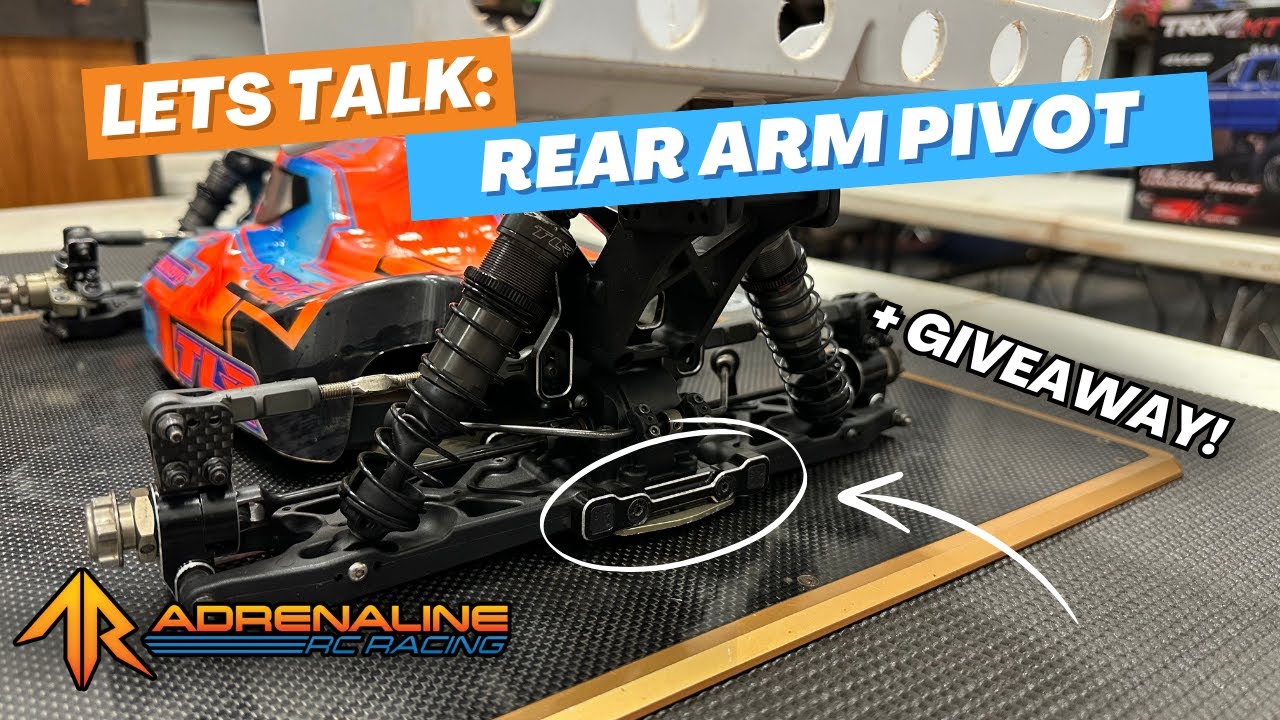
Welcome back! In a previous video, we explored front pivot block tuning (A & B blocks). Today, we’re shifting focus to the rear pivot blocks—the C and D blocks—and how adjusting them affects your RC car’s performance.
Whether you’re racing on high-grip clay, a looser dirt track, or something in between, understanding rear pivot block tuning is key to unlocking better handling, grip, and stability.
Key Adjustments in Rear Pivot Block Tuning
When tuning the C and D blocks, there are three main adjustments to consider:
-
Pin Height – where the hinge pin sits vertically (higher or lower in the block).
-
Anti-Squat Angle – the tilt of the rear pin from front to back.
-
Pivot Width – how narrow or wide the pins sit relative to the chassis.
Each adjustment has a big impact on how your buggy handles braking, acceleration, and cornering.
Pin Height: Stability vs. Acceleration Grip
-
Lower Pin (closer to the ground):
-
More side-to-side traction.
-
Car feels stable under braking.
-
Can feel a bit looser when accelerating out of turns.
-
-
Higher Pin (closer to the tower):
-
More on-power grip, especially exiting corners.
-
Can feel less stable under braking, with reduced side grip.
-
👉 Most U.S.-style tracks favor a low or middle setting rather than the extreme high position, balancing stability with on-power traction.
Anti-Squat: Power Delivery & Jump Feel
Anti-squat is the angle created when the front (C block) sits higher than the rear (D block).
-
More Anti-Squat (steeper angle):
-
Less chassis squat under power = better on-power grip.
-
Quicker rotation when off-power.
-
Slightly more “pop” off jumps, but stiffer on bumps.
-
Best for smooth, high-grip tracks.
-
-
Flatter Arm (less anti-squat):
-
More rear grip off-power, less on-power traction.
-
Softer feel = better at absorbing bumps.
-
Best for rough or looser tracks.
-
👉 In short: more anti-squat for smooth, high-grip tracks, flatter setup for bumpy, low-grip conditions.
Pivot Width: Narrow vs. Wide
The width between the pivot pins also plays a big role in handling.
-
Narrow Pivot:
-
Increases weight transfer (more chassis roll).
-
Adds rear grip on low-traction tracks.
-
Too narrow on high-grip surfaces can overload the tires and reduce traction.
-
-
Wide Pivot:
-
Reduces weight transfer (less roll).
-
Increases stability on high-grip tracks.
-
Helps prevent traction rolling.
-
👉 Use narrow pivots for loose tracks to gain grip, and wide pivots for high grip tracks to keep the buggy flat and stable.
Complimentary Adjustments to Remember
Whenever you make rear pivot block changes, don’t forget to check these:
-
Droop: Moving the pins up/down or in/out changes the arm’s position relative to the chassis. Always re-check droop.
-
Camber: Adjust camber after width changes to keep settings consistent (e.g., -2°).
-
Camber Link Geometry: Optional fine-tuning if you want to maintain exact geometry after pivot changes.
A Quick Word on Rear Toe
Rear pivot blocks also allow toe-in adjustments, but that’s a separate tuning area. Jacob already has a dedicated video covering rear toe setup if you want to dive deeper into that.
Final Thoughts
Rear pivot block tuning is all about finding balance for your track conditions:
-
Pin height = braking stability vs. acceleration grip.
-
Anti-squat = smoother bumps vs. on-power rotation.
-
Pivot width = more grip vs. more stability.
Experiment with small changes, keep notes, and see what makes your buggy feel the most comfortable for your driving style and track surface.