
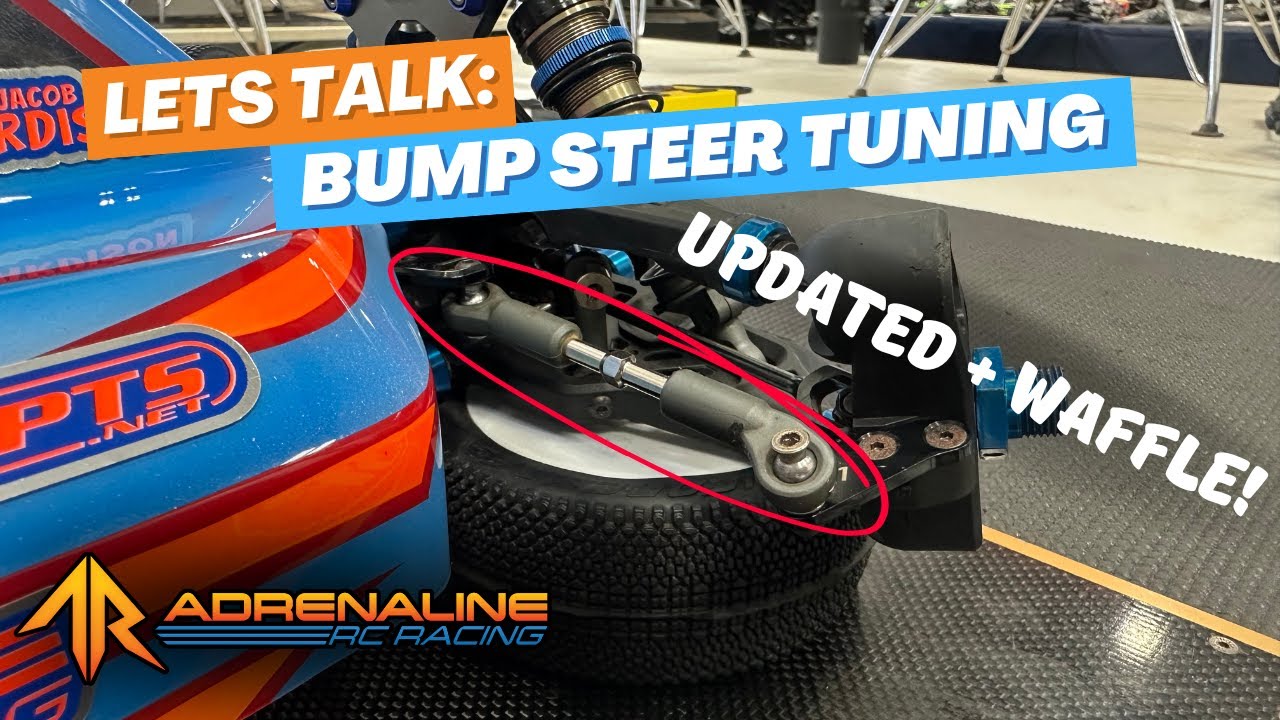
By Jacob Hardison – Adrenaline RC Racing
What’s up everybody! In today’s post, we’re diving back into one of the most talked-about (and debated) tuning topics in RC racing: bump steer.
After our original video dropped, we received some great feedback, and I wanted to take this opportunity to revisit bump steer with a clearer explanation and more detailed visuals!
What Is Bump Steer?
Bump steer refers to the change in toe angle of your front wheels as your suspension compresses or extends. It's a byproduct of suspension geometry, and while not usually adjusted directly, it can have a major impact on how your car handles through corners, especially on different track surfaces.
A Quick Visual Breakdown
In the video, we used my B4 buggy to visually demonstrate what happens when you adjust caster (via the upper arm position) and how it indirectly affects bump steer:
-
Forward Arm Position (More Caster): As the suspension compresses, the front wheels toe out—this is known as “bump out.”
-
Rearward Arm Position (Less Caster): Compression results in a less aggressive toe change, meaning the wheels stay more neutral.
We also showed how extension impacts toe angle. Bump steer isn’t just about compression—it continues to influence the car as the suspension unloads, especially during acceleration out of a corner.
How to Identify It
With the tire removed, we focused on the steering link's angle. This link's position—whether angled up or down—determines the toe change as the suspension moves.
You can manipulate bump steer with:
-
Washer adjustments under the steering linkage or rack
-
Caster changes (upper arm location or caster block)
-
Kickup adjustments
Just remember: not every change affects bump steer. Moving your shock position, for example, won’t have the same impact.
What Bump Steer Does on Track
Let’s break it down into two phases: corner entry and corner exit.
📉 On Corner Entry (Compression)
-
Toe Out Under Compression (Bump Out):
-
Smooths out steering
-
Reduces aggression
-
Ideal for choppy tracks to prevent the front end from catching or biting too hard
-
-
Toe In Under Compression (Bump In):
-
Increases steering aggression
-
Helps the car “dig” into corners
-
Best for smooth tracks where precision outweighs stability
-
📈 On Corner Exit (Extension)
-
Toe Out on Extension:
-
Car exits turns more smoothly
-
Better throttle control
-
Less twitchy under acceleration
-
-
Toe In on Extension:
-
Creates a more aggressive response
-
Might help on tight, technical layouts
-
Can feel too “grabby” on loose or bumpy tracks
-
Why This Matters
Understanding and tuning bump steer can be the difference between a planted, predictable car and one that feels inconsistent or twitchy. It’s not always the first thing racers adjust, but it’s one of the most powerful tools when you’re chasing precision and feel.