
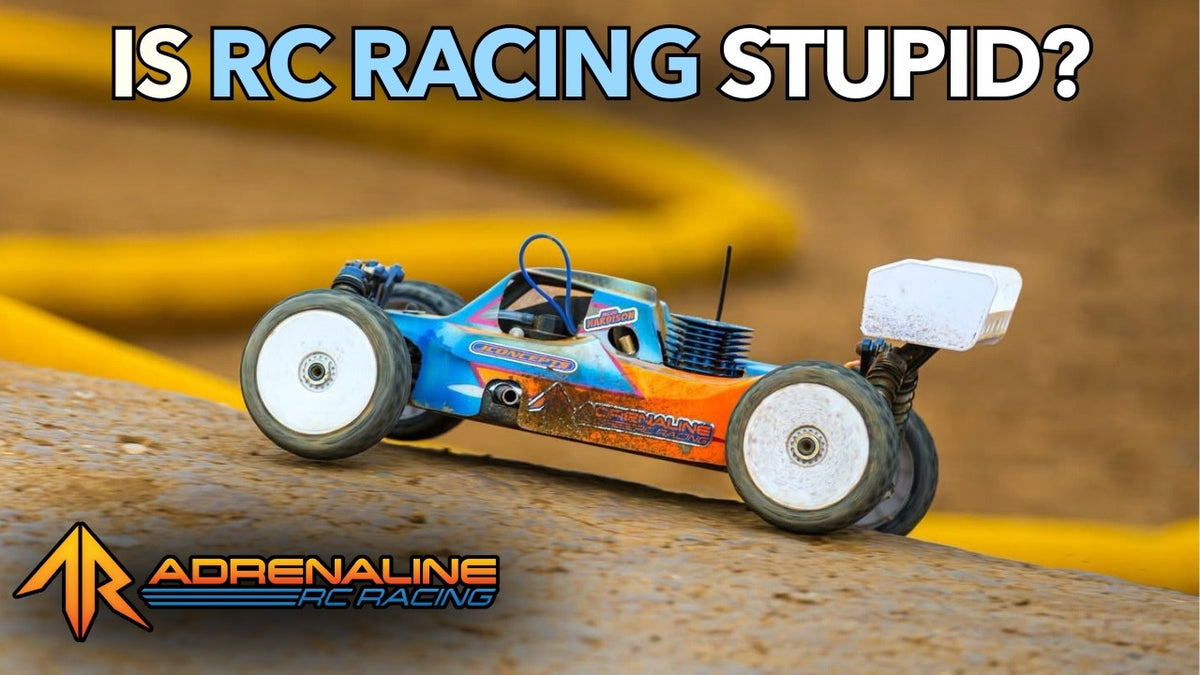
Almost every off-road RC race you've been to qualifies the same way: five or six minutes on the clock, as many laps as you can get, best total wins. It's been the standard for so long that most of us never question it. But should it be?
In our latest YouTube video, we take on a slightly controversial question: is laps-and-time qualifying actually the best way to qualify an RC race? Our answer is no, and we think top three consecutive is a better, fairer format. We've been running it at Adrenaline RC for years. Here's why.
How Laps-and-Time Qualifying Works
In a traditional laps-and-time qualifier, your personal clock starts when you cross the timing loop. You have a fixed window, almost always 5 or 6 minutes, to complete as many laps as possible. Whoever turns the most laps in the shortest total time takes the top spot.
That means the winning strategy is a clean, consistent run from start to finish. Any lost second anywhere in those six minutes counts against you. And that's exactly where the problem starts.
The Problem: Your Qualifying Run Isn't Just About You
Qualifying should measure one thing: what you can do as a driver. If you make a mistake, that's on you. But laps-and-time puts a lot of things outside your control into the result.
1. Traffic costs everyone time
Any time you come up on a slower car, or a faster car comes up on you, someone has to give. Either you check up and wait for a gap, or the car ahead blows off the racing line to let you through. Usually the car moving over loses the most, but both drivers lose time, no matter who's in the right.
On a tight field, that can be the difference between TQ and sixth. For a driver near the bubble, letting a faster car by can be the difference between the last spot in the A-main and the top of the B-main.
2. Wrecks, take-outs, and marshals
You're on an absolute heater of a run and a car stacks up right in front of you. Now you either thread the needle around it or you collect it. Or someone else takes you out. Or a marshal drops a car right on your line while trying to flip it. None of that reflects your driving, but in laps-and-time it all goes on your scorecard.
3. One mistake ruins the whole round
Lose a tire, tag a pipe, or go out on the wrong compound, and your entire qualifier is effectively over. That pressure tends to make drivers run reserved and protect the run rather than push for pace.
How Other Forms of Motorsport Qualify
Here's what got us thinking: we can't name another major form of circuit racing that qualifies on total laps and time. Formula 1 qualifies on single fastest lap. Motocross and Supercross qualifying sessions are also ranked on best single lap time. (Rally is its own animal, with point-to-point stages timed start to finish.)
If you know of a series that does use a laps-and-time style qualifier, tell us in the comments. We're happy to be proven wrong. But it does raise the question of why RC is doing something different from the rest of motorsport.
The Better Option: Top Three Consecutive Laps
With top three consecutive, you're ranked on your fastest combined time across any three laps in a row during the qualifier. Laps 1-2-3, 2-3-4, 7-8-9: it doesn't matter which, as long as they're back to back. Many tracks already use this number for seeding. We think it should be the qualifying format, too.
Why three laps instead of one?
We could copy F1 and go with single fastest lap, or use a top-five average. The problem with single lap is that some drivers can rip one blistering lap and then spend the rest of the round off the track. It doesn't seem right for someone to TQ the A-main and then finish ten laps down on the winner because they nailed one lap.
RC also has a much wider skill gap than pro motorsport. Anybody can sign up and race, while a series like F1 has a fixed set of seats. Three consecutive laps keeps the focus on raw speed while still requiring enough consistency to string together a clean stretch. It's the best mix of both.
What happens when something goes wrong?
This is where top three consecutive really shines:
- Traffic only costs you that stretch. Get held up on lap 4? Your next three clean laps still count.
- A wreck in front of you doesn't end your round. Reset and put down three more.
- You can fix and go back out. Lose a tire or realize you're on the wrong setup, make the change, get back on track, and still have a real shot at your best qualifying position.
- Drivers can push harder. Instead of babysitting a six-minute run, you're chasing pace, which is what qualifying should be about.
A common pushback we hear: "What if something bad happens on my third lap every single time?" Fair question. But in laps-and-time, that same bad luck hits you every time too, and it counts against the whole run. With top three consecutive, a bad lap only affects that one window. For the vast majority of runs, you'll get three good laps in a row without outside interference.
Laps and Time vs Top Three Consecutive at a Glance
| Laps and Time | Top Three Consecutive | |
|---|---|---|
| What's measured | Total laps in 5–6 minutes | Fastest 3 back-to-back laps |
| Impact of traffic | Counts against your whole run | Only affects that stretch |
| Wrecks and marshaling | Can ruin the round | Reset and go again |
| Mid-round repairs | Round is effectively over | Fix it and still post a time |
| Driving style | Reserved, protect the run | Push for pace |
| Consistency required | Full 5–6 minutes | Three clean laps in a row |
A Format We Believe In, Even When It Doesn't Favor Us
Full transparency: our best runs usually come from consistency more than raw speed. On paper, laps-and-time might suit our driving better. We still think top three consecutive is the right way to qualify, because it gives the truest picture of what each driver can do on the track.
We also know it's different, and not everyone who races with us is sold on it yet. That's okay. Top three consecutive felt weird to us once too. But we think the more tracks try it, the more racers will come to prefer it.
An Experiment Worth Running
Here's something we'd love to dig into: take an event's seeding order, its qualifying order, and its final results, and compare all three. Do seeding and qualifying end up close? Which one predicts the mains better? We haven't run those numbers yet, and we don't know which way they'd point, but it would be a great conversation starter.
Got a Better Idea? We Want to Hear It
We're not claiming top three consecutive is the final answer. Scoring software like LiveTime already gives race directors plenty of options, and if you've got a format that beats both laps-and-time and top three consecutive, let's hear it. There's always room to improve.
Watch the full video above and drop your take in the YouTube comments. Are you team laps-and-time or team top three consecutive?
Try Top Three Consecutive at Adrenaline RC
We'll keep running top three consecutive qualifying at Adrenaline RC Racing. The best way to make up your mind is to experience it yourself, so come out, race with us for the day, and see how it feels. While you're here, browse our full lineup of RC cars, parts, and tires to get your ride dialed before qualifying.
Frequently Asked Questions
What is laps and time qualifying in RC racing?
Each driver's clock starts when they cross the timing loop, and the goal is to complete as many laps as possible in a set window, usually 5 or 6 minutes. Ties are broken by total time.
What does top three consecutive mean?
It ranks drivers by their fastest combined time across any three laps in a row during the qualifier, whether that's laps 1-2-3 or 6-7-8.
Why not just use single fastest lap like Formula 1?
RC fields have a much wider range of skill levels than pro motorsport. Three consecutive laps still rewards speed, but requires enough consistency that one lucky lap can't put a driver at the top of the A-main.
Does Adrenaline RC use top three consecutive qualifying?
Yes, and we have for several years. Come race with us and try it out.